1997
Web-only courses: The majority of available credit is based upon Web assignments and interaction. The Web is the primary medium for student learning.
Web courses: A significant portion of available credit is Web-based. The Web is a significant medium for student learning.
Courses with Web components: Some required element is available only via the Web. Some student learning takes place via the Web.
Courses which use the Web solely to publicize syllabi, assignments, and other structural information are not included.
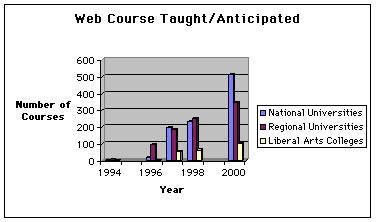
Web Courses Taught or Anticipated
Respondents were asked (in 1997) how many Web courses (with the above definition) their institution had taught three years ago and one year ago. They were also asked how many were being taught in 1997 and how many would be taught in one year (1998) and in three years (2000). Unfortunately, 4 institutions gave no data and several did not give data for all years.
Among those reporting the relevant numbers, the average ratios of the number of Web courses anticipated in 1998 to the number taught in 1997 was 1.79. The average ratio of the number of Web courses anticipated in 2000 to the number taught in 1997 was 8.19. This exhibits an expectation of a doubling time of one year.
Another way of looking at this trend is to look at that total numbers reported. These are summarized in the following chart and table. The data should be viewed only as a trend since some institutions gave data for 2000 without giving data for 1998 and vice versa.
|
1994 |
1996 |
1997 |
1998 |
2000 |
|
|
National Universities |
2 |
19 |
194 |
233 |
510 |
|
Regional Universities |
3 |
93 |
186 |
249 |
347 |
|
Liberal Arts Colleges |
0 |
1 |
53 |
62 |
100 |
Enrollment in Web courses.
Respondents were asked whether enrollment in courses that used the Web had increased, decreased, or remained the same. 10 of those offering such course could not respond to this. Of those reporting, 12 reported increased enrollment, 3 reported enrollment had stayed the same, 0 reported decreased enrollment.
Involvement by Discipline Group
Respondents were asked to rate the involvement of each of the following discipline groups in offering and developing courses that utilize the Web for student learning. A score of 1 is "not involved" and a score of 5 is "very involved". The following table reports the averages of the responses:
|
All |
National Univ. (5) |
Regional Univ. (7) |
Liberal Arts Colleges (3) |
|
|
Mathematics |
2.06 |
2.29 |
1.83 |
2.00 |
|
Science |
2.57 |
2.20 |
2.67 |
3.00 |
|
English |
2.00 |
2.00 |
2.50 |
1.00 |
|
Visual and Performing Arts |
1.69 |
2.00 |
1.67 |
1.00 |
|
Foreign Language |
2.31 |
2.43 |
2.67 |
1.33 |
|
Engineering and Computer Science |
3.50 |
3.25 |
4.00 |
2.50 |
|
Business |
3.25 |
3.14 |
3.86 |
2.50 |
|
Career Training Programs |
2.67 |
2.67 |
3.00 |
1.00 |
Uses of the Web for Learning
Respondents were asked whether the Web is best used as a SUPPLEMENT to traditional education, as an ALTERNATIVE to traditional education, as BOTH, or as NEITHER.
|
|
National Universities |
Regional Universities |
Liberal Arts Colleges |
|
Supplement |
2 |
5 |
3 |
|
Alternative |
0 |
1 |
0 |
|
Both |
3 |
5 |
0 |
|
Neither |
0 |
0 |
0 |
|
No Response or Don’t Know |
3 |
1 |
2 |
Impression of Effectiveness of Web-based Learning
Respondents were asked to give their impression of the effectiveness of using the Web for student learning. 1 is "totally ineffective" and 5 is "totally effective".
|
All |
National Universities |
Regional Universities |
Liberal Arts Colleges |
|
3.7 |
3.8 |
3.8 |
only one reporting (2) |
Respondents were asked whether their institution had a funded program designed to increase and develop future course offerings on the web. If yes, respondents were asked to report the funding level in terms of dollars and staff FTE.
Survey prepared and processed by Robby Robson and Dan Webert, University Honors College, Oregon State University. © 1997 Oregon State University. All Rights Reserved.